Moon Phases and the Traditional Japanese Calendar: Living with New Moon and Full Moon Rhythms

Looking up at the night sky, there is an instinctive calm that comes over us when noticing the slender arc of a crescent moon or the gentle, ambient illumination of a full moon.
Throughout Japanese history, people looked to the waxing and waning of the moon not merely as a nighttime wonder, but as an intimate celestial clock governing daily life. In Shinto traditions, the custom of worshiping at home shrines (kamidana) specifically on the 1st and 15th of each month is directly rooted in the rhythm of the new moon and full moon.
In this guide, we explore why the moon changes shape, how the traditional lunisolar calendar shaped Japanese culture, and how you can weave these gentle cosmic intervals into a grounding personal prayer practice today.
How Moon Phases Work: From New Moon to Full Moon
The moon shines by reflecting the light of the sun. As the moon orbits the Earth, the relative positions of the sun, Earth, and moon constantly shift. Consequently, the sunlit portion of the moon's surface visible from our vantage point on Earth also changes. This repeating progression is known as the cycle of moon phases.
A new moon occurs when the moon lies in roughly the same direction as the sun. Because its illuminated hemisphere faces away from the Earth, the moon is virtually invisible to the naked eye.
From that moment, the visible illuminated curve expands, appearing first as a delicate crescent in the western evening twilight, then progressing to the half-circle of the waxing first quarter. When the moon moves into the direction opposite the sun as seen from Earth, almost its entire illuminated surface faces us, greeting the world as a luminous full moon.
After reaching fullness, the lit area begins to decrease through the waning third quarter, returning once again to darkness before a new moon. The cycle from one new moon to the next averages about 29.5 days (approximately 29 days, 12 hours, and 44 minutes).
The Traditional Lunisolar Calendar vs. Modern Calendar: The Meaning of the 1st and 15th
In ancient and pre-modern Japan, months were counted based directly on this synodic lunar cycle. Under the traditional lunisolar calendar (kyureki), the day containing the astronomical moment of the new moon (saku) was designated as the first day of each month (tsuitachi). Counting from that start, the 15th day of the month (jugonichi, whose evening is called jugoya, the "fifteenth night") fell around the time of the full moon (bo), though the exact astronomical full moon varied by a day or two around the 15th.
However, counting an entire solar year strictly by lunar cycles (12 lunar months equal roughly 354 days) leaves a discrepancy of about 11 days each year compared to the Earth's orbit around the sun (365.24 days). Left uncorrected, calendar months would quickly drift away from actual seasonal events like planting and harvesting.
To harmonize celestial time with terrestrial life, the traditional calendar incorporated the sun's seasonal path through the 24 solar terms (Nijushisekki) and inserted an intercalary or "leap month" (uruuzuki) approximately once every two to three years. Because this system balanced both lunar phases and solar seasons, it is termed a lunisolar calendar.
Since adopting the Gregorian solar calendar in 1873, modern calendar dates are counted independently of lunar phases, so the 1st and 15th of the month do not necessarily coincide with the new and full moons. Understanding this distinction allows us to appreciate both the calendar dates and actual sky watching without confusion.
Milestones of Prayer at the Kamidana: Gratitude and Peace
At a household kamidana, in addition to everyday morning prayers, it is a cherished tradition to worship with special reverence on monthly milestones—notably the 1st and 15th—as well as family anniversaries and New Year's Day.
Under the traditional calendar, the 1st coincided with the new moon (saku) and the 15th fell around the full moon (bo), linking the visible phases of the moon with monthly calendar milestones. On these days, households would tend their altars with special care, thanking the kami for everyday safety and praying for continued harmony.
In contemporary life, many families continue this rhythm by setting aside the 1st and 15th of the calendar month to reset their homes and altars. Others observe the actual astronomical new and full moons as personal markers of reflection. Both approaches provide meaningful anchors amidst a fast-paced world.
Weaving Lunar Rhythms into Modern Life with the Kamidana App
In modern urban living, surrounded by artificial streetlights and digital screens, it can be easy to lose touch with natural cycles. Setting up and maintaining a wooden shrine shelf may also feel daunting in apartments or busy routines.
The Kamidana App was designed to bring this tranquil tradition into your pocket—providing a quiet, distraction-free sanctuary where you can pause, reflect, and center yourself whenever you need.
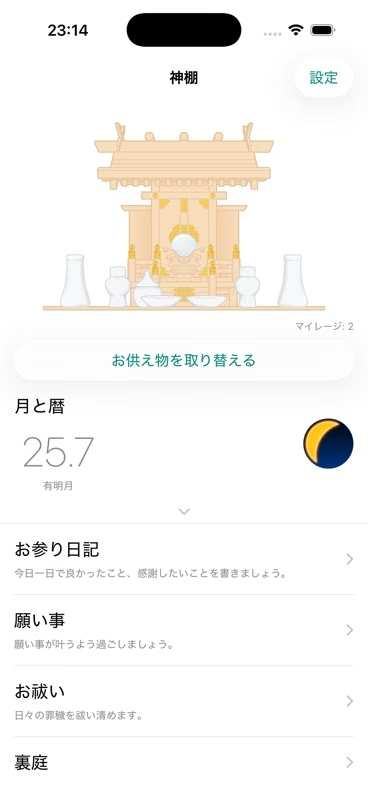
While Shinto tradition does not prescribe doctrinal rules or effects for each moon phase, if you wish to use the rhythm of the moon as a personal guide for reflection in modern life, consider these two complementary milestones:
- New Moon or the 1st of the month: Take a quiet morning moment to open the app, refresh your digital offerings, and clarify your intentions. Record a sincere wish or commitment for the weeks ahead.
- Full Moon or the 15th of the month: Pause in the evening to reflect on what has unfolded. Express gratitude for the small blessings and help you received, recognizing the efforts you have made.
You do not need an elaborate setup or rigid perfection. Simply taking thirty seconds to breathe deeply, gaze upon a serene altar, and offer sincere thanks creates a rhythmic boundary between daily busyness and inner peace.
Bring a gentle rhythm of gratitude into your daily life
Short on space or time for a traditional altar? With the Kamidana App, you can tend to daily offerings, hold quiet moments of gratitude, and follow the natural flow of the seasons directly from your phone.
Editorial and sourcing policy
Astronomical definitions and traditional calendar explanations in this article reference official materials published by the National Astronomical Observatory of Japan (NAOJ) and home worship guides from Shinto Shrine Agencies. Practices may vary by region and household tradition.