The Meaning of Katashiro & Shinto Purification: Letting Go of Worries

There are feelings we cannot easily share with others—unspoken frustrations, lingering regrets, or sudden anxieties that weigh upon our minds. We want to give them voice, yet we do not wish to publish them on social media, nor do we want to preserve them in a diary to reread later.
In Shinto tradition, impurities and heavy burdens accumulated through living are addressed through gentle rituals of harai (purification)—entrusting what weighs upon us to water, spoken words, and sacred paper effigies known as katashiro.
This guide explores the mythic roots of Shinto cleansing, the meaning behind katashiro surrogates, and how this ancient wisdom can offer modern clarity in everyday life.
The Roots of Harai and Misogi: Mythology of Purity
Harai (purification) is the foundational Shinto practice of dispelling transgressions and impurities (kegare) to restore natural purity to body and mind. It is involved in diverse moments—from everyday shrine visits to festivals and annual milestones—serving as the threshold before stepping into the presence of the kami.
In Shinto thought, kegare is explained in several ways: broadly as conditions requiring ritual cleansing before approaching the kami, and in one well-known interpretation, in connection with ki-gare—a state where vital spirit and innate freshness feel clouded or depleted through everyday living. Restoring clarity and renewal lies at the heart of Shinto cleansing.
Izanagi-no-Mikoto and the Origin of Water Purification (Misogi)
Purifying the body with water is called misogi. In Japanese mythology, after returning from Yomi-no-kuni (the underworld), the deity Izanagi-no-Mikoto immersed himself in seawater to cleanse away the impurities of the underworld. This mythic act is revered as the origin of misogi.
The familiar practice of temizu—rinsing your hands and mouth before approaching a Shinto shrine—is a simplified form of misogi. Through sacred water and spoken prayers, Shinto has handed down the art of washing away the dust of everyday living.
What Is a Katashiro? Entrusting Burdens to a Surrogate
Katashiro (形代) are ritual objects used as human surrogates to receive transgressions, worries, and impurities so they can be purified. While paper cut into the outline of a human silhouette (hitogata or hitokata) is most commonly used, some are made of wood or straw.
During the semi-annual Oharae (Great Purification) held at Shinto shrines, there is a traditional rite: a person writes their name and age on a katashiro, gently strokes it against their body, and breathes upon it three times. In doing so, they consciously entrust their mental burdens, fatigue, and regrets to the surrogate paper, which is then presented to the shrine for purification.
Setting Afloat on Rivers and Burning with Sacred Flame
Once received, katashiro are treated with solemn ritual care. Traditionally, they are either set afloat on rivers or the sea to dissolve into pure water (ryūkyaku-shinji), or ritually burned in purifying shrine fires.
By giving visible form to internal turmoil and releasing it through a physical surrogate, people discover a profound psychological and spiritual release—leaving their burdens in the hands of the kami and returning to life with renewed clarity.
Separating a Journal from "Purification"
In modern life, writing helps us untangle complex thoughts. Yet preserving every raw emotion, frustration, or passing anxiety in a journal can accidentally turn our notebooks into monuments of past stress, prompting us to re-experience negative moments.
A healthier approach is to separate what we record:
- Prayer Journal (Omairi Nikki): For cherished milestones, gratitude, hopes, and positive intentions you wish to nurture over time.
- Purification (Oharai & Katashiro): For raw worries, fears, and unresolved thoughts you simply need to express once and let go.
No Need for Polite Eloquence
What you write on a katashiro can be the incident itself, words left unsaid, or emotions still stirring in your chest. Because this is not a message to another human, there is no need to polish your grammar or explain context. Write in whatever simple words capture what you wish to release.
The Kamidana App's Purification Feature
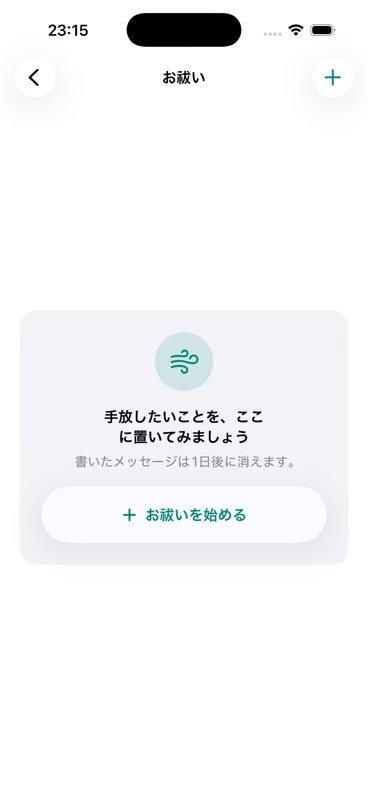
The Kamidana App brings this ancient practice into your daily digital routine, creating a secure, quiet sanctuary right on your phone.
How the Digital Purification Works
- Put your lingering worry or unspoken thought into words on the digital katashiro.
- Offer it before the sacred altar, acknowledging that you have released it from your grip.
- Entries older than 24 hours are removed the next time you open the purification screen (behavior and display may vary depending on your installed app version).
- Close the app, take a deep, steady breath, and return to your daily responsibilities.
This feature is not medical therapy or a guarantee that external challenges will vanish on their own. Rather, it serves as a gentle ritual boundary: giving you permission to set down emotional baggage you cannot carry alone, so you can direct your energy toward today's practical care.
Summary: Cultivating a Rhythm of Quiet Renewal
The true essence of Shinto purification is rooted in the ideal of tokowaka (eternal renewal)—not striving for impossible flawlessness, but cultivating the grace to reset and restore your natural clarity whenever clouds appear.
- Minor worries and emotional fatigue naturally accumulate in daily life.
- Katashiro offers a sacred surrogate to hold what you cannot carry alone.
- Record gratitude in your journal; release heavy burdens through purification.
- Letting go allows you to return to today with patience, kindness, and renewed vitality.
You don't need to carry everything at once. Entrust what is past to the kami, embrace the quiet stillness of the moment, and step forward with a refreshed heart.
Release What You Cannot Carry, Step Forward with Clarity
Experience the quiet relief of releasing lingering thoughts into sacred stillness. With the Kamidana App, you can place digital offerings and practice peaceful purification wherever you are.
Editorial Policy & References
This article references information on Shinto misogi, purification rites, kegare interpretations, and Great Purification ceremonies published by Jinja Honcho, Kokugakuin University, and Kanda Myoujin.