Tsuitachi Mairi (1st & 15th Shrine Visits): Why Japan Prays Twice a Month and How to Practice Today

In Japan, it is common to see people visiting local Shinto shrines early in the morning on the 1st and 15th of each month. Businesses refresh their shrine shelves, and families gather before their household kamidana to present special offerings.
Visiting on the first day of the month is known as Tsuitachi Mairi (朔日参り), while visiting on the fifteenth is Jugonichi Mairi (十五日参り). Together, they create a natural bi-weekly cadence of gratitude and grounding.
Why were these two dates chosen? How does this custom connect to the moon phases of the traditional lunar calendar? And how can you bring this gentle rhythm into your modern life even without a physical shrine shelf? Here is your guide.
1. The Custom of Praying on the 1st and 15th
Alongside daily prayers, Japanese tradition has long placed special value on the 1st and the 15th as essential monthly milestones.
While Shinto tradition does not assign separate doctrinal meanings to the 1st and the 15th—both are occasions for thanksgiving and worship—in modern life you can use these two dates as intentional resting points to structure your month:
- The 1st (Tsuitachi): Expressing gratitude for having arrived safely at the start of a fresh month, clarifying intentions, and praying for the family’s health and steady work in the weeks ahead.
- The 15th (Jugonichi): Pausing at the mid-month checkpoint to give thanks for the peaceful passage of the first two weeks and gently review your pace for the second half of the month.
By framing each month with a clear beginning and middle, this practice prevents time from feeling like an overwhelming sprint, turning it instead into a mindful, rhythmic journey.
2. Origins in the Moon: Traditional Lunar Roots vs. Modern Calendars
Why did the 1st and the 15th become such enduring milestones? The answer lies in Japan’s traditional lunisolar calendar (Kyūreki) and the visible phases of the moon.
The Traditional Lunisolar Calendar (Saku and Bo)
In pre-modern Japan’s lunisolar calendar, dates were directly bound to the moon’s cycle:
- The 1st day of the month (Tsuitachi): Defined as the calendar day containing the astronomical moment of the new moon (saku), marking the start of a new lunar month.
- The 15th day of the month (Jugonichi): Counted fifteen days from the 1st (with its evening referred to as jugoya, the "fifteenth night"), this date fell around the time of the full moon (bō)—because the moon’s orbital speed varies, the exact moment of the full moon (bō) occurred around the 14th to the 17th rather than always on the 15th itself.
In today’s solar Gregorian calendar, dates are counted independently of lunar phases, so the 1st and 15th do not necessarily coincide with the new and full moons. Understanding this distinction avoids confusion: today, the 1st and 15th serve as practical calendar benchmarks, while the astronomical new and full moons can be enjoyed as separate, poetic reminders of nature’s flow.
3. Shrine and Kamidana Offerings for the 1st and 15th
On these two milestone mornings, worshipers enhance their standard daily offerings to create a more festive and reverent atmosphere.
Special Offerings and the "Tsuitachi Sekihan" Custom
- Omiki (Sacred Rice Wine): Poured into a pair of porcelain flasks (heishi) and placed to the left and right of the central rice dish.
- Fresh Seasonal Fruits & Vegetables: Adding a small plate of seasonal produce—fresh apples, persimmons, greens, or regional gifts—expresses gratitude for nature’s bountiful sustenance.
- Refreshing the Sakaki: Water in the sakaki vases is refreshed, and any wilted branches are replaced with vibrant evergreen sprigs (the 1st and 15th are standard days for renewing sakaki).
A beloved Japanese household custom on the first of each month is preparing Tsuitachi Sekihan (red bean rice). In traditional folklore, the vibrant natural crimson of azuki beans is believed to dispel negative energies and protect against misfortune. Presenting fresh sekihan before the kamidana and enjoying it with family on the 1st marks a spirited beginning, welcoming vitality and health for the month ahead.
After prayer, the offerings are lowered as osagari (divine gifts). Sharing the food in a meal or using the wine in cooking embodies shinjin kyōshoku—communing with the sacred by nourishing the body with blessed provisions.
4. Modern Practice: Bi-Weekly Mindfulness with the Kamidana App
If you don’t live near a Shinto shrine or don’t have space at home for a wooden altar, you can still easily cultivate this bi-weekly cadence.
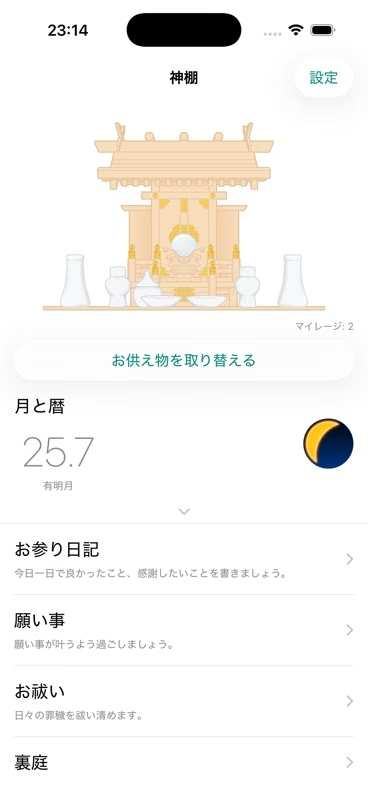
Structuring Your 1st and 15th in the App
The Kamidana App allows you to hold a quiet, contemplative moment in seconds:
- On the 1st: Set Your Core Monthly Intention
Open the app, present fresh digital water, and use the wish feature to write down a clear focal theme: "This month, I will practice patience and take proper rest." - On the 15th: Mid-Month Check-In and Thanks
Check in at the mid-point. Review your initial intention without self-criticism: "Have I taken care of myself over the past two weeks? What can I adjust for the rest of the month?"
Praying the same simple prayer on both days is equally meaningful. Having these two pre-set checkpoints anchors your calendar, ensuring you never go too long without a moment of stillness.
5. Summary: Embracing a Calmer Living Rhythm
In an age of relentless speed, the tradition of Tsuitachi and Jugonichi Mairi is a comforting gift: permission to step off the treadmill twice a month and reset your heart.
- The 1st welcomes new beginnings; the 15th offers a gentle mid-month review.
- Rooted in the new moon (Saku) and full-moon-period (Bo) milestones of the traditional lunisolar calendar.
- Marked traditionally with sake, seasonal produce, and fresh evergreen sakaki.
- Easily adapted through the Kamidana App as a peaceful digital ritual.
When the next 1st or 15th arrives, take thirty seconds to close your eyes, take a calm breath, and offer sincere thanks. That small pause can illuminate your entire month.
Bring a moment of quiet gratitude to your day
Looking for an easy way to keep up with the 1st and 15th shrine traditions? The Kamidana App brings peaceful offerings and intention-setting directly to your smartphone, helping you stay grounded throughout the month without extra stress.
Editorial and sourcing policy
This article references official explanations of monthly shrine visits, household altar offerings, and calendar systems published by the Hokkaido Jinja-cho and the National Astronomical Observatory of Japan (NAOJ). Offering varieties and worship schedules may differ by regional shrine tradition.