Entrusting What Lies Beyond Your Control: Finding Peace in Prayer After Doing Your Best

After dedicating yourself wholeheartedly to a task and completing all the preparation within your power, the period of waiting for the outcome can feel restless and heavy.
Whether waiting for the results of a demanding examination, anticipating a response to a pivotal business proposal, or praying for a loved one's recovery from illness, no amount of careful preparation completely silences the worry: "What if things do not unfold as I had hoped?"
Yet there is an inherent boundary to what personal strength alone can dictate.
One meaningful approach to prayer in Japan is to do what lies within your own power, and then entrust what lies beyond human reach to the watchful care of the kami—allowing you to let go of anxious urgency and return to a peaceful daily rhythm.
Disentangling What We Control from What We Must Entrust
When working toward an important wish or milestone, everything before us falls into two distinct realms: what lies within our personal agency, and what lies beyond our solitary power.
Recognizing the Boundaries of Personal Effort
Thorough preparation, diligent practice, keeping your word, and communicating with honesty and kindness—these are your personal actions. They belong entirely to your own choices and efforts.
In contrast, how another person judges your efforts, how wider market conditions or weather shift, and what opportunities or unexpected encounters emerge in the future cannot be determined by yourself alone.
When the boundary between these two realms blurs, we can find ourselves trying to carry outcomes and other people's responses that cannot be decided by one person alone, which often leads to inner tension, sleepless nights, and exhaustion.
Seeking Divine Protection in the Kamidana Haishi
In prayers asking for the protection (kago) of the kami, we also pray for things that cannot be decided by our own strength alone.
The traditional liturgy of the Kamidana Haishi reflects this balance: it records both diligent effort in daily duties and heartfelt prayers for the health, harmony, and prosperity of the family.
Entrusting What Lies Beyond Personal Strength
As highlighted in teachings from Jinja Honcho on shrine worship, standing before the kami is a moment to offer gratitude for daily blessings and ask for watchful protection over what lies beyond solitary human reach.
Having done all that is within your reach, you bring before the kami those matters that cannot be decided by your personal strength alone. In bowing your head, you acknowledge: "I have offered my utmost effort. The rest I entrust to the watchful care of the kami."
Entrusting the outcome is not defeat; it is an act of trust that eases the feeling of trying to carry everything alone and restores a grounded calm.
Releasing Urgency to Return to Daily Calm
Entrusting an outcome to the kami is fundamentally different from giving up in despair.
Once preparation is complete, prayer serves as a gentle ceremony of closure—a conscious moment to place down the heavy luggage of worry before the altar so you can return to living today with presence and clarity.
How to Navigate the Waiting Period
While waiting for results, frantically forcing unnecessary actions out of anxiety rarely improves the situation. Often, it only increases tension for yourself and those around you.
While waiting for results, if you notice something new and constructive you can do, take action with care. If the situation does not change, you can continue praying for the same wish quietly, attending to your daily meals, rest, and work with ordinary tenderness.
Knowing that your sincere wishes have been placed into the watchful care of the kami allows you to wait not with dread, but with quiet peace.
Sorting Action and Entrusting in the Kamidana App
Amidst the flurry of modern schedules and digital notifications, keeping your thoughts organized and maintaining mental calm can be challenging.
The Kamidana App provides a private, quiet space on your phone to clarify your intentions, record your steps, and practice the art of entrusting.
Write What You Will Do; Entrust What Lies Beyond
When writing a wish in the app, first write down what you will do personally, and then clarify what you entrust to the watchful care of the kami.
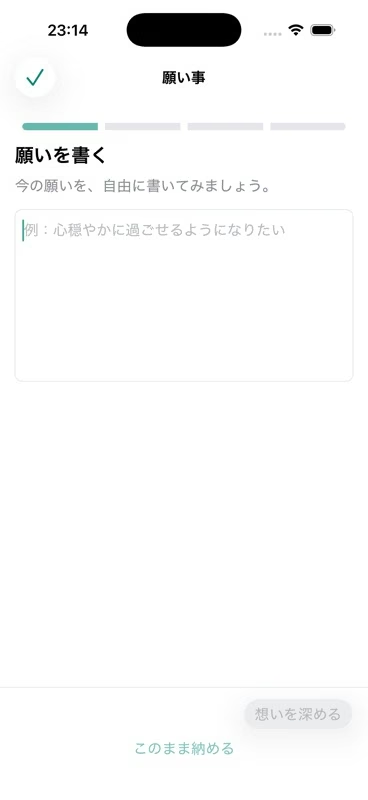
Even after completing your own preparations, you can pray to the kami for the desired outcome and continue your daily worship with simplicity.
Focusing on what you can do, while entrusting the rest to the kami, offers a quiet place to hold your prayers even while waiting for results to unfold.
A Simple, Grounded Practice for Busy Modern Lives
With the Kamidana App, you can place quiet wishes and daily reflections directly on your smartphone. Build a steady rhythm of gratitude and calm integrity—without requiring a large traditional altar or complicated rituals.
Editorial & Sourcing Policy
This article references modern translations of traditional Kamidana Haishi and shrine worship protocols published by Jinja Honcho and the Hokkaido Jinja Cho. Personal prayer habits and household rituals can be tailored to your individual lifestyle and living space.